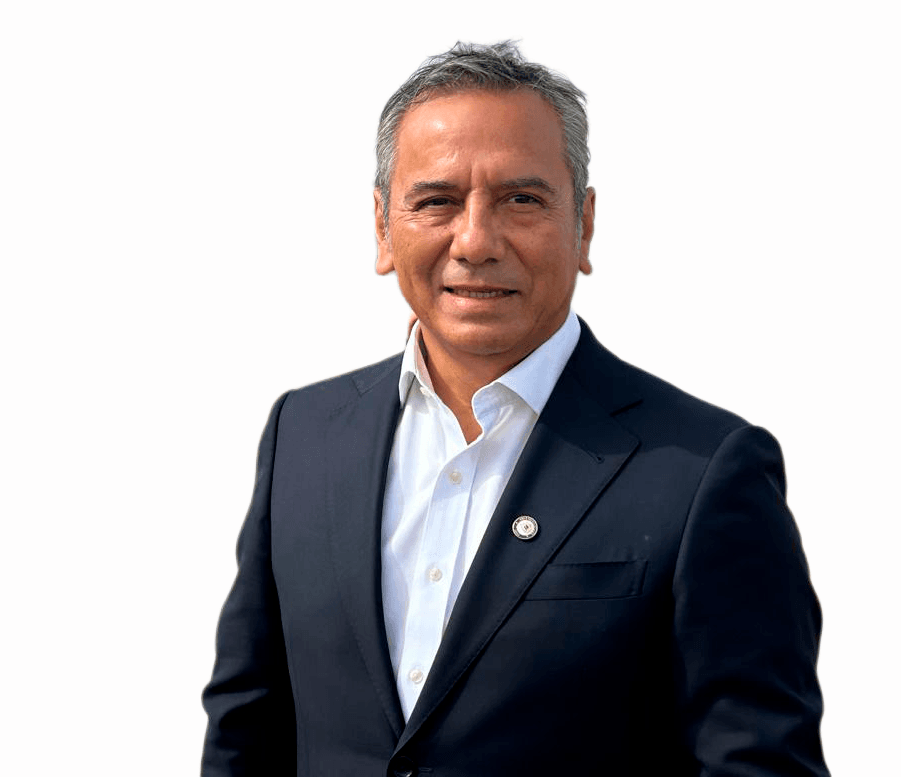
In an interview with PortalPortuario, Carlos Escobar Olguín, General Manager of Puerto Antofagasta, discussed the development of port and inland infrastructure, the opportunities presented by the Bioceanic Corridor and the port’s relationship with the city.
The full interview, conducted by Sebastián Betancourt for the specialist publication, follows.
How is Puerto Antofagasta progressing in response to growth challenges and the Bioceanic Corridor?
Puerto Antofagasta is experiencing an important moment in its historical development because of the number of projects moving into execution. We established a course of action quite some time ago and have been following it through a master plan, with a vision of playing an important role in the logistics chain of the region that contributes the most to the country’s exports.
Between 8% and 10% of Chile’s FOB export value passes through Puerto Antofagasta, which is significant. The Antofagasta Region currently accounts for between 40% and 45% of the country’s FOB export value, as measured by the region’s customs offices, predominantly through maritime exports shipped from its port complexes.
What projects are you developing?
We are implementing strategic projects intended to increase or sustain our port capacity so that export processes meet the needs of the country’s strategic industries. Copper, lithium and mining supplies move through Puerto Antofagasta, along with some cargo from Bolivia under an international treaty. Chile also has other treaties to fulfil, such as the one with Paraguay.
There is optimism about the development of the Bioceanic Corridor, which the different countries have been promoting. This creates expectations of development and cargo growth, not only for Puerto Antofagasta but also for the region’s other ports. Within this context, we set out to modernise the port so that it can become part of the country’s strategic port network in the Antofagasta Region and northern Chile.
What does this modernisation involve?
We identified projects such as the breakwater expansion, which is intended to unlock modernisation within the port and reduce the number of days it closes because of swell conditions. These conditions have been increasing and affect ports throughout the region, both in Mejillones Bay and in San Jorge Bay, where our port is located.
We therefore have a responsibility to address this issue. That is what the breakwater expansion seeks to do, and work has already begun.
We conducted a successful tender process and construction has started. The project is on the schedule, and we expect the breakwater expansion to be completed in approximately two and a half years, towards the end of 2028. There is also a dredging project for which we had the opportunity to hold a roadshow with many companies to discuss the tender process.
We are also very enthusiastic about achieving greater depth so that the harbour basin meets the standard required by a port located in a region of such strategic importance to the country.
Do you have other initiatives in the pipeline?
We have other projects, such as improving the fenders at Berthing Area 1, which is currently underused. We see these as projects that can act as catalysts for doubling the port’s operational capacity, which currently stands at 3.5 million tonnes.
As a complement to this, because we are no longer talking simply about a port node but about a much more complex logistics system, Puerto Antofagasta also developed a strategic project in La Negra. It provides space for businesses connected with port logistics, mining, which drives the country’s economy, and the future Bioceanic Corridor. This is the La Negra project, located in the upper part of the city.
Is the La Negra project continuing to develop?
Last year, we completed the works providing the area’s basic infrastructure. This year, we tendered two complementary projects: the access road running between Ruta 5 and the La Negra Logistics Development Zone, and a truck rest area. Trucks operating in the area will have a serviced space where drivers can park and wait for their cargo in good conditions.
We also brought forward the development of an area for small and medium-sized enterprises, which already has 75% occupancy, with contracts being signed and a large proportion already completed. We expect to reach 100% by the end of the year. This space allows small businesses connected with port operations, logistics, mining and the circular economy to establish themselves and develop something different.
Considering existing capacity, the capacity being developed and integration with neighbouring countries, could the Antofagasta Region be described as a logistics hub?
We already have significant experience. Approximately 500,000 tonnes of cargo from Bolivia, mainly minerals, move through Puerto Antofagasta within a successful logistics system. Trains arrive from Bolivia, and between 80% and 90% of the cargo comes by rail.
At certain times, during the Bolivian winter or when supply problems arise, trucks bring goods to Portezuelo, a terminal with warehouse facilities. A second phase has already been developed with a major company in the sector, which operates within the terminal, and we are in discussions about further expansion.
Returning to your question about whether the region is becoming a logistics hub, I would say yes. Given the region’s importance, its number of ports and the volume it handles, it is a logistics hub because we are connected with all the industries in our region, with neighbouring countries and, of course, with other regions.
These connections are provided by rail and trucks. We have roads and projects for new routes under development in the region. I believe there is still work to do, but we are moving in that direction. There is growing awareness of the role port logistics plays in regional development.
What developments are planned to expand that terminal?
Our plans for Portezuelo include extending the railway, which currently connects to the main line through a branch entering our terminal, where there is a truck-washing system. It also has a rotating-container system, in which we were pioneers. We have therefore met the region’s stringent environmental requirements.
We anticipated these developments. We have a clean production agreement that is among the most successful: the logistics, mining and port clean production agreement. Mining companies, Puerto Antofagasta, hauliers and other participants made the necessary efforts to modernise this logistics system, which is now delivering very positive results.
An annual survey is conducted in Antofagasta, the Barómetro, by the Public Policy Institute at Universidad Católica del Norte. Over the past four years, we have ranked as the company with the highest level of trust. That makes us pleased, but it also increases our workload because we must maintain that level: the public is placing its trust in what we do.
This makes us proud as a port, but it also demands greater responsibility, and that is what we are working on.
How do you build and strengthen the relationship between the port and the Antofagasta community?
It is a long-term effort, carried out every day. Trust comes first: the processes we say we have must be real, our measurements must be accurate, there must be transparency, and we must be open to the community. We have a team that, together with the community, has been developing an agenda connecting the port’s development with the city’s needs and expectations. Scheduled visits to the port are part of that work.
We are part of the city’s development. We participate in seminars, work with stakeholder groups in Antofagasta and show people our facilities.
We always try to stay in contact with schools and neighbourhood associations. We also participate in business associations and belong to them to present our projects, explain where we are heading and show the employment the port generates, extending beyond its core port activities. The port has a property business and a shopping centre, which is unusual among Chilean ports and generates substantial employment.
This also creates a space where the port and the city interact every day.
What does the port’s location within the city imply?
We understand our limitations because we are located in central Antofagasta, in the area that has developed the most. The arrival of the shopping centre created a significant urban space, and south of the port there is a waterfront highly valued by local residents. We are therefore constantly in the public eye. There will always be people who still have concerns, and we must be able to respond continuously about everything we do.
How is the growing importance of port logistics being reflected?
Previously, the focus was solely on mining. Today, within the Antofagasta Industrial Association, we see that port and logistics issues are important because people recognise that these activities must be well developed. We must have the best technologies and deliver on what we communicate to the community so that the region can continue to develop.
Through what we have achieved, we secured broad support from the Regional Council in a process through which the Regional Government contributed, under an agreement, part of the investment funding for projects we submitted. I would say this shows that the community and its representatives see the port as a place for development, opportunities and job creation. Naturally, we must also fulfil our role in improving quality of life.
We have several projects connected with the waterfront. We are considering initiatives in the southern and northern areas that can improve quality of life for the city and its residents.
Do you see the port terminals in Mejillones Bay as complementary?
They are absolutely complementary. We must compete because that is what is expected. We must take steps to compete, and so must they. This must happen within clear ground rules, with transparency and fair play, which are essential. As both we and they perform well, the region benefits, creating more opportunities and attracting more businesses interested in establishing operations in the area.
They are therefore very important to us, and I hope we are also very important to them.
What about Iquique and Tocopilla?
They are also looking towards the Bioceanic Corridor. We have different hinterlands in terms of the companies moving cargo and their objectives. That is positive because it is part of competition. We must have a transparent process without imbalances or monopolies. This is part of our work, and it is the direction in which we have consistently progressed.
The same applies when we run supplier tenders. We seek to ensure that prospective bidders are fully informed so that as many as possible can participate, with the transparency and professionalism these processes require.
What challenges do northern Chile’s ports, and Puerto Antofagasta in particular, face?
For the north in general, the challenge is to remain at the forefront of technology, be highly transparent and meet communities’ environmental expectations. We still have work to do on decarbonisation. Port activities present challenges, and we must continue providing indicators showing that we go beyond regulatory requirements in environmental matters and public participation.
The port’s development strategy is also built on this. If the port does not maintain a good relationship with the community, if it operates behind the community’s back, it will disappear, as will any port that behaves that way. However important it may be, someone else will emerge who does things properly. That is a challenge.
Another fundamental priority is serving the valuable industries already operating in the region and progressively adapting and improving our infrastructure, starting with what already exists and the customers who currently require port services. On that basis, we can strengthen integration with neighbouring countries and create conditions to attract new cargo flows, such as those associated with the Bioceanic Corridor.
Does the development of Peruvian ports concern you?
The development of large-scale ports in the region may influence the size of vessels that call, but we are talking about large cargo volumes that will continue to require maritime transport, and ships will go where the cargo is. In that context, northern ports can compete if they have one or two berths with the scale and conditions needed to serve those vessels.
How do you see Puerto Antofagasta’s future?
Promising, with a highly developed port. The works we are advancing have a 50-year horizon. A port tender process for a 30-year concession is approaching, and we are preparing for it in advance. What we do and decide now will be fundamental. We are therefore focused on doing things well and getting the details right, bearing in mind that the infrastructure developed through this process will remain with us until 2065.
This is the time to think carefully about everything the port can develop and ensure healthy competition among those interested in contributing to that development. The decisions we make today will define the port Antofagasta will have for future generations.
Source: PortalPortuario.